Charles Boone
'Salem's Lot: A NovelCharles Boone is the central witness and final intended sacrifice of the 1850 events surrounding Chapelwaite and Jerusalem’s Lot. His account begins with an heir entering a decaying estate and develops into a record of supernatural discovery, bodily collapse, the destruction of a forbidden book, and the recognition that the Boone family itself is bound to the evil beneath the two places. His decisive significance lies in the final reversal: the man who tries to end the horror discovers that his own blood is the last link preserving it.
Identity and Entry into the Horror
Charles Boone presents his experience through letters addressed to his friend Bones, giving the narrative the form of a private account written close to the events it describes. On October 2, 1850, he arrives at Chapelwaite exhausted by an abominable coach journey and finds Bones’s letter waiting on a small cherry-wood table in the cold, draughty hall. The physical discomfort of the arrival is set against the estate’s oppressive atmosphere: the grounds have returned to wilderness, with junipers, scrub vines, bushes, and creepers overrunning the stone walls, while damaged Greek statuary seems poised to attack passers-by. Charles therefore enters not an ordinary inheritance but a house whose neglected material surroundings already register menace.
His first decisive movement is outward, away from the estate and toward the abandoned settlement later identified as Jerusalem’s Lot. With Cal, he travels through silent pine stands, hearing only their footsteps and the Atlantic pounding against the headlands. At about eleven o’clock they cross an overgrown corduroy road and reach a boiling, slaty stream. Beyond its moss-grown footbridge stands a preserved but weathered village of austere Puritan houses, primitive business establishments, and a church spire with peeled paint and a tarnished, leaning cross. The setting turns geographical discovery into a threshold crossing: Charles has found the place that explains the unease of Chapelwaite, even before he understands what connects them.
Investigation, Collapse, and Moral Resolve
By October 22, Charles writes that he is physically recovering after thirty-six hours of unconsciousness, but rejects the idea that he can simply return to his former life. He says that he has confronted an insanity and horror beyond human expression and that the ordeal is not finished. His dependence on Cal is explicit: without his friend, Charles believes he might end his life, while Cal functions as an island of sanity within the surrounding madness. The letter thus records both a crisis of perception and the effort to preserve a moral witness when ordinary explanations have failed.
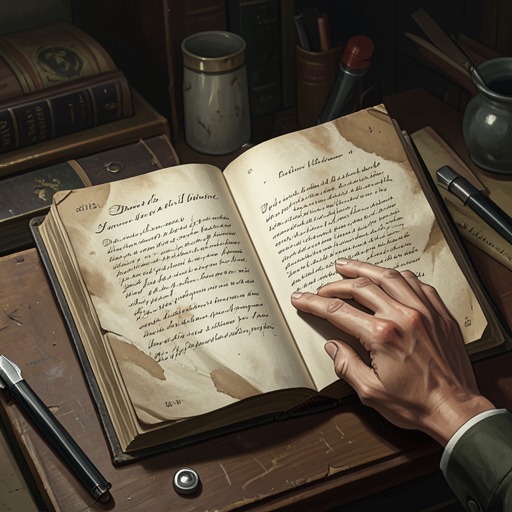
The investigation reaches its clearest ethical decision in the church. A lamb has been violently crushed, its blood collecting around the lectern while remaining transparent over a book whose crabbed runes can still be read through it. Cal asks whether the object must be touched, and Charles answers that he must have it. He then defines his purpose in historical terms: he will do what should have been done sixty years earlier and destroy the book. The decision is not curiosity for its own sake. Charles treats the book as an active instrument of inherited evil, and its destruction as a delayed obligation owed to the living.
The attempt succeeds only partially. Burning the book thwarts the entity associated with it, but Charles learns that other copies exist. The discovery converts a local victory into a continuing threat: destroying the visible object has interrupted the evil without eliminating its source or its transmission. Charles’s investigation therefore produces knowledge at the cost of security. Each answer enlarges the danger, and the act that appears most final becomes another stage in the struggle.
The James Boon Revelation
The most devastating revelation comes when Charles encounters a corpse-like figure rising from darkness. Its half-skull is covered with beetles, a rotted cassock hangs from mouldered collar-bones, and only its red, insane eyes retain life. Charles understands that the apparition has come to take him into darkness, but the supernatural attack becomes personally intelligible when he recognizes a family resemblance in the ruined face.
He does not identify the figure as Philip or Robert Boone, whose likenesses hang in the upstairs gallery. Instead, the face belongs to James Boon, remembered as the Keeper of the Worm. This recognition transforms the horror from an external haunting into a hereditary history. The evil beneath Jerusalem’s Lot and Chapelwaite is not merely occupying a place that Charles has inherited; it is connected to a Boone ancestor whose posthumous presence still governs the buried mystery. Charles’s family knowledge, rather than protecting him, supplies the final clue that makes the threat comprehensible.
His response is immediate flight. He leaves the body of his lifelong friend unheeded, runs until the effort seems to burst his lungs and brain, and collapses in his room after reaching the possessed and tainted house. The retreat is both physical and moral: Charles abandons his friend because terror has overwhelmed his capacity to remain at the scene, yet the flight also preserves the revelation that makes his final decision possible. He returns to Chapelwaite not as a survivor who has escaped the evil, but as the person most completely implicated in it.
Bloodline, Sacrifice, and Ending
Charles concludes that James Boon still lives somewhere in the twisted, lightless passages beneath Jerusalem’s Lot and Chapelwaite, and that the entity itself still lives as well. The burned book has delayed it, but the existence of other copies means that no single act of destruction can secure humanity. Charles then identifies himself as the gateway and the last of the Boone blood. This is the central change in his character’s position: he begins as an heir investigating a sinister inheritance and ends as the living mechanism through which that inheritance may continue.
His final objective is consequently self-annihilation. Charles states that he must die for the good of all humanity and break the chain forever. The act is presented not as personal despair alone, although his trauma and exhaustion are extreme, but as a deliberate sacrifice shaped by knowledge. He has seen that the evil survives beneath the landscape, that the book exists in multiple copies, and that his lineage provides its access. Death becomes his chosen attempt to close the gateway that investigation has revealed.
He ends by going to the sea, declaring that his journey, like his story, has reached its end. Because the narrative is conveyed through his letter to Bones, this departure is both an action and a final act of authorship: Charles records the evidence, names the hereditary connection, warns that the evil remains, and then removes himself as the last Boone link. The ending offers no triumphant return and no assurance that the supernatural threat has been destroyed. Its bleak force comes from the contrast between Charles’s successful destruction of one copy of the book and his failure to erase the larger system of copies, blood, place, and buried history.
Narrative Function and Significance
Charles is a round figure defined by a credible progression from confidence in inherited property, through exploratory curiosity and dependence on Cal, to physical collapse, terror, and sacrificial resolve. His experience follows an inverted heroic pattern. He crosses a threshold into Jerusalem’s Lot, confronts a hidden power, gains the knowledge needed to oppose it, and returns to Chapelwaite; but the knowledge does not equip him to restore the ordinary world. Instead, it identifies him as the final danger within that world and makes self-destruction the only remaining form of agency.
The epistolary form intensifies this trajectory. Addressing Bones directly, Charles records concrete sensations, locations, objects, and bodily consequences as though each letter were an attempt to impose sequence on events that have exceeded ordinary language. The October 2 arrival establishes the house and the village as ominous spaces; the October 22 letter announces that the witness has been permanently changed; the closing message fuses confession, warning, and farewell. His narrative is therefore not only a report of supernatural events but also the last testimony of a man who understands that telling the story may be the final service he can perform before ending the bloodline that made him its gateway.